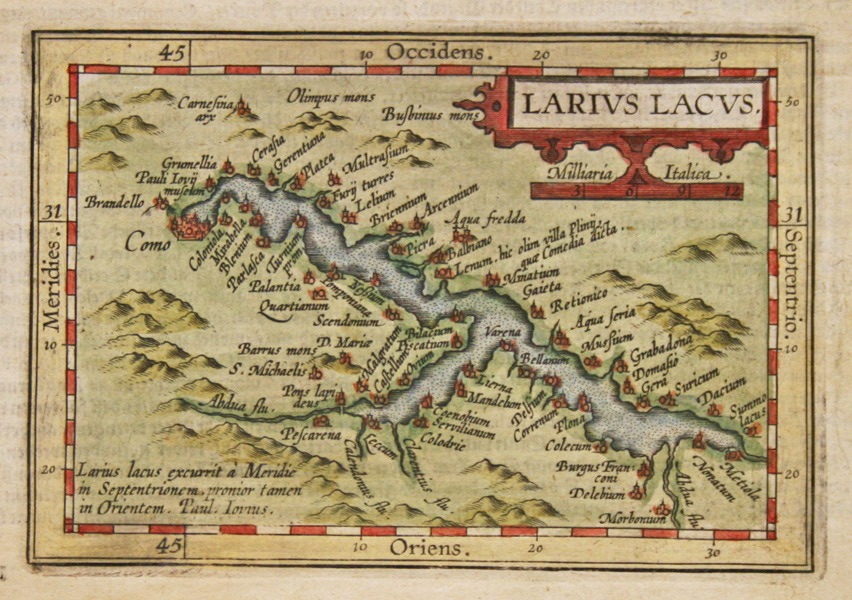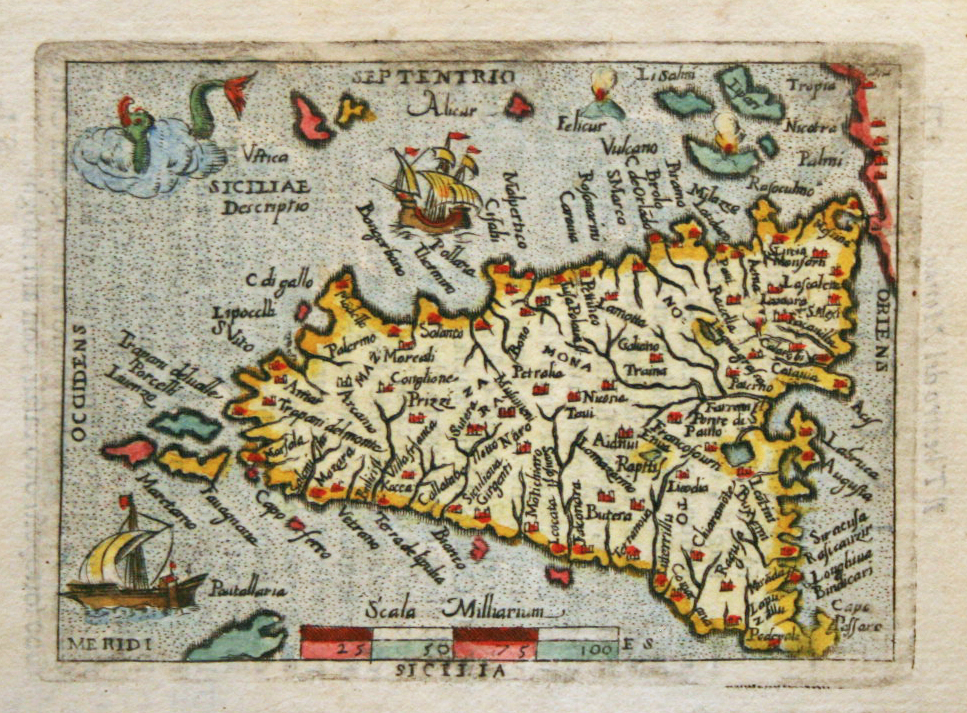
Abraham Ortelius (1527 – 1598) is regarded as one of the most prominent cartographers of the sixteenth century. Born in Antwerp where he was educated in the classics and mathematics, he began his career in cartography as an illuminator or 'painter of maps' and opened a bookstore in partnership with his sister. In the course of his business, he traveled throughout Europe and established important contacts with cartographers and other literati. Between 1564 and 1570 he produced several of his own maps including a large map of the world on eight sheets. It was not however, until the publication of the Theatrum Orbis Terrarum (Theatre of the World) in 1570 that Ortelius' place in history was assured.
Abraham Ortelius (1527 – 1598) is regarded as one of the most prominent cartographers of the sixteenth century. Born in Antwerp where he was educated in the classics and mathematics, he began his career in cartography as an illuminator or ‘painter of maps’ and opened a bookstore in partnership with his sister. In the course of his business, he traveled throughout Europe and established important contacts with cartographers and other literati. Between 1564 and 1570 he produced several of his own maps including a large map of the world on eight sheets. It was not however, until the publication of the Theatrum Orbis Terrarum (Theatre of the World) in 1570 that Ortelius’ place in history was assured.
Ortelius’s Theatrum (as it is often called) is considered the first true atlas, although Mercator coined the term atlas twenty years later. This book gathered together for the first time a collection of uniformly sized maps and related text bound to form a book. Although Lafreri and others in Italy had published collections of ‘modern’ maps in book form in earlier years, the maps had not been specifically engraved for the project and the books were assembled to suit the needs of the individual customer. Ortelius departed from the Italian model and created a compilation of maps and narratives that were presented logically to represent the world, continents, regions and nations. Therefore, it was an encyclopedic description of the world and a milestone in cartographic history.
In an era when citing references were the exception rather than the rule, Ortelius was one of the best bibliographers of early cartography. The Theatrum included a list of sources to provide readers with a historical context for the maps. This list included the thirty-three cartographers whose maps Ortelius consulted, as well as, all eighty-seven geographers known to him. Many of Theatrum’s maps were based upon sources that no longer existed or were extremely rare.
Ortelius employed the most prominent engravers, printers and colorists in the production of his atlas. Most of the maps were elegantly engraved by Frans Hogenberg and have a distinctive style of elaborate strapwork cartouches and bold borders. The oceans were generally stipple engraved, mountains were shown as picturesque rolling hills, and towering castles and church spires depicted cities. Ortelius’ daughter learned the skill of illumination from her father and colored the special presentation atlases with rich washes and jewel-like pigments.
Apart from the modern maps in the Theatrum, Ortelius himself designed a series of historical maps known as the Parergon Theatri, which appeared from 1579 onwards, sometimes as a separate publication and sometimes incorporated in the Theatrum.
After the initial release of Theatrum Orbis Terrarum in 1570, Ortelius regularly revised and expanded the atlas, reissuing it until his death in 1598. His heirs transferred publication rights to Jan Baptiste Vrients who produced the later editions until he died in 1612. During this period, over seventy-three hundred copies were printed in thirty-one editions and seven different languages. Throughout its publication history, the Theatrum Orbis Terrarum was the undisputed leader in the field of European atlas making.