The Christina Gallery

On the Island of Martha’s Vineyard

  • Art
    • Artists
    • Original Paintings
    • Mini Boats
    • Modern Masters Collection
    • French Fashion Prints
    • Botanicals
    • Sailors Valentines
    • Burgees
    • Hand Colored Engravings
    • Watercolors
    • Prints
  • Maps
    • Cartographers
    • Massachusetts
    • New England
    • New York
    • World Maps
    • All Map Areas
  • On Sale
    • Original Paintings
    • Modern Masters Collection
    • Maps on Sale
    • Nautical Charts on Sale
    • Limited Edition Prints

The Christina Gallery

  • Tour
  • News & Blog
  • About

November 2012 Archives

Les Maitres de l’Affiche

Jules Chéret is universally known as the master of the modern poster. Born in 1836 Paris into a creative family, Chéret had little formal education yet through an apprenticeship he was exposed to the art of lithography. From 1859 to 1866 he moved to London to continue his lithography training. Inspired by British posters and design techniques and the French Rococo style, Chéret applied his knowledge of printmaking towards creating ads promoting cabarets, theaters and other popular social outlets. By the end of his career he had become a major advertising force, working for all manners of clients including beverage companies and the railroads.

From 1895 to 1900, Chéret produced Les Maîtres de l’Affiche, a publication of high-quality smaller-scale iterations of popular posters from Le Belle Époque period by ninety seven top Parisian artists. Each month four lithographs were mailed out to each of the subscribers. On sixteen occasions, an additional ‘special edition’ lithograph would also be included. Today these 256 prints are extremely rare and in high demand with collectors across the globe.
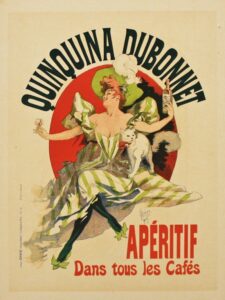
"Quinquina Dubonnet" by Jules Cheret Caption reads: Quinquina Dubonnet / Aperitif available in all cafes.
“Quinquina Dubonnet” by Jules Cheret
Caption reads: Quinquina Dubonnet / Aperitif available in all cafes.

“Quinquina Dubonnet” is from Les Maitres de l’Affiche. This poster by Chéret is indicative of the style for which he was known. He often portrayed spirited, flirtatious, yet elegant women, who became known as ‘Cherettes.’ These women were neither the prostitutes nor the puritans seen in many works of the time. Chéret’s modern depiction of women was seen as liberating to contemporary Parisian women. “Quinquina Dubonnet” is no exception. Here we see a young socialite sitting with her legs crossed, revealing her ankles, with her arms extended to the sides and her head thrown back in joyous laughter. In one hand she holds a bottle of Dubonnet and in the other, a glass full of the drink. The advertisement reads “Quinquina Dubonnet / Apéritif available in all cafés.” Chéret understood how to get the public’s attention and engage them in advertisements. Editions of this particular print are in collections here at The Christina Gallery as well as in the permanent collection at The Museum of Modern Art in New York.

Check out our website here to view more lithographs from Les Maîtres de l’Affiche or visit us in Edgartown, MA to see them in person!
Painting En Plein Air

Plein air painting was first popularized by the impressionists in the 1870s. For centuries artists have been painting outdoors on location, but it wasn’t until the advent of metal tubes of oil paint that painting en plein air truly became a movement. Finally, artists were able to easily transport their supplies to whatever location they chose and paint on site. Prior to the introduction of paint tubes, artists had to mix their own pigments individually each time they desired to use a particular color. Paints would dry out quickly and so it was simply impractical to attempt to move a palette and supplies outdoors, far away from one’s studio.

Impressionists fully embraced plein air painting. This method was directly in line with their goal of capturing the magic of light and the essence of the landscape. Painting on location encourages the artist to work quickly to capture the mood of the setting. This can often account for the energetic brushstrokes seen in Impressionist canvases. Artists of all time periods and styles worked outdoors from life, but often they would only sketch or draft the composition they saw before them. The final paintings were reserved for the shelter of the indoor studio. Impressionists such as Vincent van Gogh challenged this method.

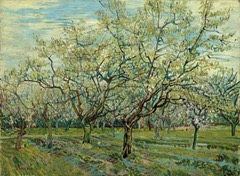
"The White Orchard" by Vincent van Gogh, 1888
“The White Orchard” by Vincent van Gogh, 1888

When inspired by an environment, he would often work fastidiously to render the scene in paint right then and there, such as in “The White Orchard” (1888). These spontaneous paintings by van Gogh and other artists like Claude Monet and Camille Pissarro define the oeuvre of the Impressionists.

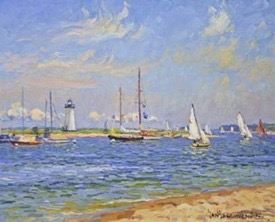
Today, Jan Pawlowski works in a similar manner to many well-known masters. “A Day for Sailing” was painted from the beach on Chappaquiddick overlooking the harbor and Edgartown lighthouse. Pawlowski was inspired by the beautiful sunny blue sky and gentle wind to capture this image of sailboats keeling in the wind in front of the lighthouse.

"A Day for Sailing" by Jan Pawlowski
“A Day for Sailing” by Jan Pawlowski

Many artists that we represent here at The Christina Gallery paint en plein air. Stop by and ask us to point out some paintings for you or see if you can pick out which paintings were painted en plein air on our website!

Archives

News

  • Contemporary Paintings
  • Sailors' Valentines
  • Antique Works
  • Antique Nautical Charts and Maps
  • Updates
  • Exhibitions
  • News
  • Blog
The Christina Gallery

The Christina Gallery
5 Winter Street
Edgartown MA 02539
508-627-8794
[email protected]

  • Facebook
  • Instagram
  • RSS
Sign up for our newsletter!

Header Image
July Afternoon, Edgartown Yacht Club
Copyright 2026 The Christina Gallery Technology by Tenseg