The Christina Gallery

On the Island of Martha’s Vineyard

  • Art
    • Artists
    • Original Paintings
    • Mini Boats
    • Modern Masters Collection
    • French Fashion Prints
    • Botanicals
    • Sailors Valentines
    • Burgees
    • Hand Colored Engravings
    • Watercolors
    • Prints
  • Maps
    • Cartographers
    • Massachusetts
    • New England
    • New York
    • World Maps
    • All Map Areas
  • On Sale
    • Original Paintings
    • Modern Masters Collection
    • Maps on Sale
    • Nautical Charts on Sale
    • Limited Edition Prints

The Christina Gallery

  • Tour
  • News & Blog
  • About

October 2012 Archives

Gazette du Bon Ton: French Fashion Plates

Lucien Vogel stirred the French fashion world in 1912 with the publication of Le Gazette du Bon Ton, a fashion journal highlighting the artistic qualities of clothing design. Perhaps if this magazine were produced today it would be equated with the likes of Vogue or ID and possibly even referred to as a commercial catalogue, but these comparisons do not do Le Gazette Bon Ton justice. From 1912-1925 Vogel issued limited edition journals of beautifully rendered fashion plates showcasing designs by avant garde fashion houses including Lanvin and Paquin.

The images printed in Le Gazette du Bon Ton were all pochoir (French for stencil) prints. This work-intensive technique creates beautiful illustrations that preserve the vibrant colors and intricate details of the original designs. Individual stencils would be cut for each color required. The stencils are then hand painted with gouache and watercolor and printed on hand-made paper.
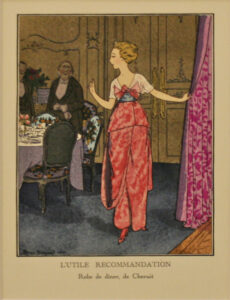
“L’Utile Recommandation”

“L’Utile Recommandation” is an exceptional example of the intricate fashion plate prints from Gazette du Bon Ton. Accompanied by the witty text, “Dinner’s ready / Dinner gown by Cheruit.” we see an image of an elegant young woman wearing a vibrantly dyed red dinner dress with a sheer overlay bodice. She looks back over her shoulder at a butler in the background, standing over a set dinner table. This woman is clearly living an enviable life full of leisure and grace. Her head is turned away from the viewer while her body faces forward allowing us to gaze at her dress without being caught staring. It is easy to infer, as the artist intended, that by purchasing this dress one also achieves part of the same quality of life. This combination of intricate imagery and tempting advertisement made Gazette du Bon Ton a very successful endeavor. It helped reinforce the public’s fascination with an idyllic life of leisure and highlighted the artistic abilities of both the fashion houses and the artists themselves who were producing these exquisite poichor prints.

Enjoy more images from Vogel’s Gazette du Bon Ton here on our website or visit us in person at The Christina Gallery in Edgartown, MA on the island of Martha’s Vineyard.
Russell Gordon: A Contemporary Realist

Russell Gordon’s realist still-life paintings are, at first glance, reminiscent of 19thcentury still lifes. Take a moment to really absorb the scene before you; however, and Gordon’s charming sense of humor and lighthearted attitude burst forth off the canvas. Gordon designs traditional compositions of objects such as fruit, mussels, and books then infuses them with his own unique brand of wit. Examine his paintings closely and you are sure to notice nuances such as a ladybug perched atop an otherwise unblemished flower or a water droplet sliding down a dewy mussel shell.

Gordon’s use of chiaroscuro heightens the drama of his compositions. He uses a very traditional, richly colored palette that lends itself to the theatricality of the seemingly simple arrangements that he portrays. Vividly colored lemons, or other objects, pop against a background of brown and burgundy. A single light source is frequently used to illuminate the foreground and provide gleaming highlights.

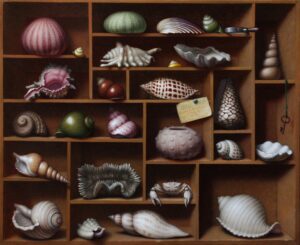
"Shell Collection" by Russell Gordon
“Shell Collection” by Russell Gordon

“Shell Collection” is a 22” x 27” oil painting of a curiosity cabinet filled with seashells. True to his nature, Gordon has included humorous references and objects such as the crab in the center of one of the bottom ‘cubes.’ The crab’s claws hang forward, moving into the viewers’ realm of reality. His eyes glisten as they stare directly ahead, watching us look at him. Gordon signs the work with a playful business card pinned to the center of the display case. The card reads, “Shell Shop / Seashells of Unique Beauty / 19 Ocean Drive / ask for Russell W. Gordon.” The detail that Gordon captures, just like in all of his paintings, is incredible. The viewer can practically count the threads that compose the green string tying the key to a nail.

Come visit us at The Christina Gallery in Edgartown, MA to spot more of the tongue-in-cheek details in Gordon’s original oil paintings, or view them here on our website.

“Les Roses” by Pierre-Joseph Redoute

Pierre-Joseph Redouté is perhaps the most famous painter of flowers in the world. He served as the official flower painter to both Queen Marie Antoinette and Empress Josephine Bonaparte of France, Napoleon’s first wife. He is best known for his work “Les Roses,” a series of stipple engravings of roses based on his watercolor paintings.

Redouté was born in 1759 in the Belgian Ardennes. Both his father and grandfather were artists and encouraged Redouté to begin painting at the age of thirteen. He began his career in religious art, modeling himself after the likes of Michelangelo and Raphael. While working at a cathedral in the Netherlands he was first introduced to the flower paintings of Van Huysum and other Dutch artists. In 1782, after this initial exposure, Redouté ventured to Paris to further his interest in botany painting by studying specimens at Jardin du Roi. While there he met Gerard van Spaendonck, an artist, and Charles Louis L’Heritier de Brutelle, an amateur botanist. Both individuals became dominant forces propelling Redouté’s career. In fact it was L’Heritier who first introduced Redouté to Marie Antoinette; a connection that soon led to his appointment as court painter.

In 1804, after six years of patronage, Empress Josephine Bonaparte took on Redouté as her official artist. Empress Josephine was known for her love of roses and is often referenced as having grown the first garden exclusively composed of roses at her home near Choisy, Chateau de Malmaison. It was her mission to collect and plant every known rose variety. To achieve this goal she worked closely with nurserymen including M. Andre du Pont, the director of the Luxembourg Gardens. Of the Empress’ extensive collection, Redouté published over 160 stipple engravings of roses from the Empresses Chateau de Malmaison. He was an avid botanist, an interest that was nurtured by his relationship with van Spaendonck, as well as an artist. It was this combination that impressed Empress Josephine and allowed Redouté to produce such exquisite, elegant and accurate renderings of each flower he painted.

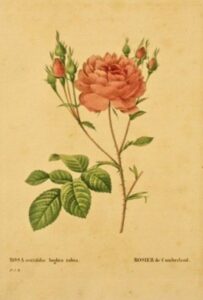
"Rose Centifolia Anglica Rubra" by Pierre-Joseph Redouté
“Rose Centifolia Anglica Rubra” by Pierre-Joseph Redouté

“Les Roses” was commissioned by Empress Josephine as a record of her extensive rose garden. Each Redouté’s career flourished and he enjoyed the success of his career merging naturalist research with timeless art. In 1828 at the height of his fame, Redouté met Jean-Jacques Audubon (or John James Audubon as he is also known). The two became close friends and supporters of each other’s work. Today they are both recognized as pioneers of iconographical botany and ornithology painting.

A number of rare original engravings from Redouté’s “Les Roses” series are on display at The Christina Gallery in Edgartown, MA. You can also view them here on our website.

Carol Fortunato: Vanitas Still Lifes

Carol Fortunato’s oil paintings are reminiscent of works by 17th century Dutch masters. Like the Baroque artists, Fortunato employs chiaroscuro (an application of intense light and dark) to add drama to her still lifes of flowers, fruits and vegetables. Her muted tones and dark palette contrast with the bright light sources that she arranges, and lends an air of mystery to her paintings. Dutch artists of the baroque period often experimented with vanitas painting. These still lives were quiet reflections on mortality. Food and flowers were used as metaphors for the fragility of life. Fortunato’s work reflects this interest in evolution, “Perhaps I focus on most things edible because at the peak of their ripeness, their fullness and vibrancy is made all the more precious by their transience—whether it’s because they are about to wither or to be eaten.”

Young White Peonies” by Carol Fortunato

A lush bouquet of white flowers blossoms out of a clear glass vase in “Young White Peonies.” Fortunato depicts the flowers at different stages in their lifecycle. The white peony in the left is in full bloom. Its petals open up, embracing sunlight and perhaps emitting a light fragrance into the air. To its right, we see another blossom lying at the base of the vase; petals strewn about in a mark of decay. These memento mori serve as reminders of the beauty of life. Fortunato’s renditions of vanitas painting are beautiful, elegant and even joyous celebrations of the value of life.

Carol Fortunato graduated with a BFA from the School of Visual Arts in New York. It was during her post-graduate training with the Art Students League under David Leffel and Greg Kreutz that she developed her interest in chiaroscuro painting, which is so dominant in her work today.

To view more original oil paintings by Carol Fortunato please visit us at The Christina Gallery on the island of Martha’s Vineyard, or here on our website.

Archives

News

  • Contemporary Paintings
  • Sailors' Valentines
  • Antique Works
  • Antique Nautical Charts and Maps
  • Updates
  • Exhibitions
  • News
  • Blog
The Christina Gallery

The Christina Gallery
5 Winter Street
Edgartown MA 02539
508-627-8794
[email protected]

  • Facebook
  • Instagram
  • RSS
Sign up for our newsletter!

Header Image
July Afternoon, Edgartown Yacht Club
Copyright 2026 The Christina Gallery Technology by Tenseg