The Christina Gallery

On the Island of Martha’s Vineyard

  • Art
    • Artists
    • Original Paintings
    • Mini Boats
    • Modern Masters Collection
    • French Fashion Prints
    • Botanicals
    • Sailors Valentines
    • Burgees
    • Hand Colored Engravings
    • Watercolors
    • Prints
  • Maps
    • Cartographers
    • Massachusetts
    • New England
    • New York
    • World Maps
    • All Map Areas
  • On Sale
    • Original Paintings
    • Modern Masters Collection
    • Maps on Sale
    • Nautical Charts on Sale
    • Limited Edition Prints

The Christina Gallery

  • Tour
  • News & Blog
  • About

September 2012 Archives

David Bareford’s Seascapes

David Bareford’s seascapes effortlessly capture the spirit of summer. His plein air oil paintings are beautiful renditions of sunny beaches and elegant sailboats. He paints each scene with a loose brushstroke and a palette dominated by sea-foam greens and cerulean blues. It is rare to find a gallery visitor looking at Bareford’s paintings without a smile crossing his or her face. His blue skies are simple and succinctly portrayed, yet they effuse connotations of heat, sun and sand and the happy memories that accompany those images. Bareford plays on the viewers’ nostalgia as he portrays faceless families gathered on beaches and majestic sailboats gliding across the water. These are all scenes that strike a personal cord for many viewers. The graceful sailboats muster up thoughts of afternoons out on the water; the children splashing about in the ocean remind us of mornings on South Beach.
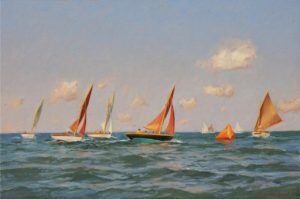
H Class Racing off Edgartown by David Bareford
“H Class Racing off Edgartown” by David Bareford

David Bareford was born in New Jersey and has been painting in New England throughout his life. He began his artistic career working in watercolors, but moved into oil paint to expand his vision. Bareford is part of a long-standing tradition of marine artists working out of Rockport, MA. He is an active member of a number of artistic societies including the Rockport Art Association and the Copley Society. You can see a selection of Bareford’s oil paintings online here or in person at The Christina Gallery in Edgartown, MA.
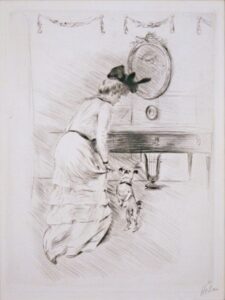
La Belle Epoque: A Look at Paul Cesar Helleu’s “Elegante de Chien Faisant le Beau”

“La Belle Epoque” was an era of great beauty, excess, innovation and renewal in France from the 1890’s until World War I. Paul César Helleu encapsulates the elegance of the time period in his work. Using oil paint, pastel and drypoint etching with a diamond stylus, Helleu is known for his animated renderings of Parisian society women. His portraits are a far cry from the structured, rigid canon that was frequently followed throughout the Victorian era. Rather than relying on the three quarter length, forward facing, hands-crossed-in-lap pose that was traditionally employed, Helleu encouraged his subjects to relax and be themselves.

The etching “Elegante de Chien Faisant le Beau” depicts a finely dressed woman crouching slightly to play with her spirited puppy. Her back is turned to the viewer, obscuring much of her face, yet she still feels familiar. Helleu introduces us to this woman through her other details. She wears an elegant tiered dress and a formal hat that clearly speak to her status as an aristocrat. The ornate molding and lavish furniture in the background of the etching also support this conclusion. The figure becomes much more personal when we consider the whimsical way she has been shown. Helleu chooses to show the woman bending forward towards an eager puppy while delicately lifting the skirt of her dress. There are very few details in this etching yet Helleu’s sparing use of line brings life to the scene.

"Elegante de Chien Faisant le Beau" by Paul César Helleu
“Elegante de Chien Faisant le Beau” by Paul César Helleu

This richly burred print is an exquisite example of Helleu’s etchings. He understood how each mark on the copper plate would translate to the paper. This knowledge helped Helleu bring his images to life. Look, for example, at the short staccato lines that compose the woman’s skirt. The lines transform into a tactile image of bustling fabric. One can almost hear her skirt rustling as she moves towards the dog.

Helleu was part of a group of artists including Tissot, Manet and Whistler who depicted Edwardian era Paris. In fact, it was Tissot himself who first introduced Helleu to the technique of using a diamond stylus to create drypoint etchings such as “Elegante de Chien Faisant le Beau.” Helleu’s most famous commission was the star-filled ceiling of Grand Central Terminal in New York City. After being covered for over six decades, the mural of the night sky was restored in 1998 and is on display for the millions of travelers passing through the train station today.

“Elegante de Chien Faisant le Beau” is currently on display at The Christina Gallery. Come visit us in Edgartown to see the etching for yourself or check out our website here to learn more about Paul César Helleu.

American Folk Art by Ted Jeremenko

It wasn’t until his mid-twenties that Ted Jeremenko discovered his love of painting. While working in the computer and banking industries, Jeremenko began his artistic career as a hobby. After the success of his first show at Jay Johnson America’s Folk Heritage on Madison Avenue, NY Jeremenko followed his passion and became a full-fledged professional artist. “I paint primarily for myself,” he explains, “but it is very gratifying to know that my artwork touches other people.”

Jeremenko’s work is very unique for its simple, geometric forms and raw view of the world. His oeuvre is very much a part of the folk art tradition. He paints landscapes scattered with houses and other architectural buildings including lighthouses and churches. Jeremenko approaches each painting with a goal of simplifying the view. Each plane is painted with a solid color, breaking down entire scenes into a handful of colors. This stylistic representation of architecture works in harmony with Jeremenko’s pointillist-inspired landscapes to create striking compositions.

"Along the Pond" by Ted Jeremenko
“Along the Pond” by Ted Jeremenko

“Along the Pond” clearly demonstrates the dualistic technique of pointillism and abstraction that Jeremenko employs. He uses color to define light, form, and a sense of space. The focal point of the painting is the red house slightly to the left of center, but the viewers’ eye moves easily around the canvas to the stark white church and on to the dark green mountains in the background. The multi-hued leaves on the trees seem to move in the breeze and it is easy to imagine each individual blade of grass that grows in this thriving landscape. Jeremenko helps the viewer see beauty in every scene. His stylized methods create a serene world filled with greenery, blue skies and composed buildings.

Jeremenko was born in Yugoslavia in 1938. He moved to Philadelphia, Pennsylvania at the age of twelve. His carefully arranged compositions and beautiful renditions of space allow us, as his viewers, to see the world through Jeremenko’s eyes.

View more acrylic paintings by Ted Jeremenko here or visit us in person to see his works for yourself.

Lush Landscapes by Curtis Hanson

When I look at a Curtis Hanson painting I’m immediately transported to a warm summer day in the lush landscape of New England or, equally as frequently, to the rice fields of Thailand. Hanson devotes himself to meditation and through this practice he has learned to observe the world around him with an astute eye and an open mind.

“As one whom has given my whole life to the practice of painting, at its heart has been that painting is an object of awareness of what it means to be alive. Through direct observation of nature both in the external and the internal world it has and continues to be a way of knowing and understanding what this life is.”
~Curt Hanson (from his blog August 18, 2010)

Hanson studied with Charles Palmer and Stan Taft at Fort Wright College in Washington State. After graduation he moved to New York City where he was influenced by the work of the Barbizon School paintings and George Inness. The Barbizon School was a movement beginning in France in the mid-19th century following John Constable’s lead portraying nature as the focal point of paintings rather than the backdrop for portraits or historical scenes. Hanson has wholly adopted this attitude towards art. Outdoor landscapes and scenes of the natural world dominate his canvases.

"Salt Marsh" by Curtis Hanson
“Salt Marsh” by Curtis Hanson

“Salt Marsh” is indicative of Hanson’s reflective painting style. His work is easily recognizable for its natural palette of green, yellow and blue based hues. He often selects calm and meditative landscapes such as this New England scene. The sky glows with glazes of pink and yellow underlay beneath the blue haze of a foggy day. The clear water mirrors crisp reflections of the trees dressing the horizon line. Hanson understands exactly how to capture the viewer’s imagination and help bring them to a place of quiet contemplation. Each canvas that he paints bathes its audience in his message of meditation.

More original oil paintings by Curtis Hanson are on view at The Christina Gallery. Come visit us in Edgartown, MA to see the full collection in person or visit us online here.

Antique Maps: A View into the Political and Social Landscape of the Past

Here at The Christina Gallery we carry a vast collection of antique maps dating back to the late 16th century and nautical charts from the 19th century. Map making has always been an important part of the history of modern society. A map conveys much more than geographic information. From antique maps we are able to rediscover the world of our ancestors and understand the interactions between different cultures, countries and empires based on the images they produced and their depictions of foreign lands.

The earliest known maps date back to the Babylonians in 3500 BCE, but it wasn’t until the invention of the printing press in the middle of the 15th century that maps were mass produced and became popular with the general public. Scientific methods of measurement were introduced to cartography in the 17th, 18th and 19th centuries. Many of the maps on display at The Christina Gallery were printed from a metal plate then colored by hand.

Novi Belgii (1671) provides an interesting window into the political environment of the 17th century. This striking map portrays the English-dominated regions of New England and includes every settlement and river along the coastline. The cartographer, Arnoldus Montanus (1625 – 1683), was a prominent Dutch minister, teacher, author, and publisher in the seventeenth century. His rendition of the New England topography has been accepted as the standard by which the Dutch understanding of the New World can be assessed, despite the fact that Montanus himself never actually visited New England. It was considered common practice for cartographers to use each other’s work as source material when creating new maps. His portrayal of New England was based on the influential mid-17th century Jansson-Visscher series of the same subject (Jansson and Visscher were also Dutch cartographers).

Novi Belgii by Arnoldus Montanus
“Novi Belgii” by Arnoldus Montanus

This particular map is remarkable because of its elaborate cartouche adorning the bottom right of the plate. Montanus has carved seven figures into the copper plate from which his map was printed, along with numerous flora and fauna. The figures shown in the title cartouche are performing several different occupations undertaken by the settlers and the natives such as hunting and trading. The interior of the map is elaborately engraved with miniature trees, rivers and indigenous animals throughout the entire image.

At the time of this map’s creation the British and Dutch governments were struggling over the ownership of land in North America. Montanus clearly declares the terrain as “Novi Belgii,” or “New Netherland” in his depiction of the newly acquired land. This bold claim provides interesting insight into the political landscape of the time. Dutch mapmakers were known for their highly-skilled work and engraving capabilities. English mapmakers were unable to compete in this department leaving Dutch cartographers to dominate the map market, and thus attempt to mark their territory through text. This allowed the Dutch government to use maps such as Montanus’ Novi Belgii as powerful propaganda tool in asserting their ownership of “New Netherland.” Montanus’ map has left us a record of the expanding reach of European powers upon the New World.

Visit us at The Christina Gallery in Edgartown, MA to see our full collection of antique maps and nautical charts or view part of our collection online here.

Archives

News

  • Contemporary Paintings
  • Sailors' Valentines
  • Antique Works
  • Antique Nautical Charts and Maps
  • Updates
  • Exhibitions
  • News
  • Blog
The Christina Gallery

The Christina Gallery
5 Winter Street
Edgartown MA 02539
508-627-8794
[email protected]

  • Facebook
  • Instagram
  • RSS
Sign up for our newsletter!

Header Image
July Afternoon, Edgartown Yacht Club
Copyright 2026 The Christina Gallery Technology by Tenseg