The Christina Gallery

On the Island of Martha’s Vineyard

  • Art
    • Artists
    • Original Paintings
    • Mini Boats
    • Modern Masters Collection
    • French Fashion Prints
    • Botanicals
    • Sailors Valentines
    • Burgees
    • Hand Colored Engravings
    • Watercolors
    • Prints
  • Maps
    • Cartographers
    • Massachusetts
    • New England
    • New York
    • World Maps
    • All Map Areas
  • On Sale
    • Original Paintings
    • Modern Masters Collection
    • Maps on Sale
    • Nautical Charts on Sale
    • Limited Edition Prints

The Christina Gallery

  • Tour
  • News & Blog
  • About

July 2012 Archives

A Look Back in Time: Historic Marine Scenes

William R. Davis has made his name as a painter of historic sea and landscapes. Known as one of the best marine painters of our time, Davis is a self-taught artist who learned to paint by studying the works of 19th century masters. Francis Silva’s works showed Davis that warm tones are pleasing to the eye, while astute observation of William Bradford’s paintings led to Davis’ technique of priming his canvas in salmon hues. The salmon under-painting results in the warm glow that marks each of Davis’ oil paintings.
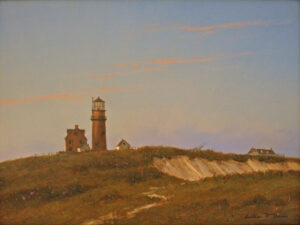
"Gay Head Light c. 1890" by William R. Davis
“Gay Head Light c. 1890” by William R. Davis

Davis was born in 1952 in Somerville, MA and grew up near the water in Hyannis where he developed a love of sailing that would last a lifetime. He has amassed a library of over one thousand texts on marine artists, historic vessels, maritime charts, and other boating related books. He thoroughly researches each landscape in order to recreate its 19th century appearance. Davis uses a gentle hand and a soft sable brush to create his carefully rendered oil paintings. His works are defined by their warm color palette, impeccably detailed subject matter, smooth surface, and atmospheric lighting. Renowned for his ability to accurately portray the billowing sheets and taught lines of a schooner, he is also unmatched in his ability to emulate the quality of light in a dewy sunrise or a pink-tinged sunset. His perceptive appreciation of light allows him to capture the power of nature in every painting. Collectors of Davis’ art praise the elegant way his brushstrokes melt into the surface of the canvas and the accuracy with which he captures the turn-of-the-century seascapes.

William R. Davis’ work is reminiscent of the American Luminism of the late eighteen hundreds. The style is defined by the use of natural light, often sunrise or sunset, in the paintings of American landscapes. Davis’ work can be found in collections and exhibitions around the world, including at The Christina Gallery in Edgartown, Martha’s Vineyard.
Lillia Frantin: A Contemporary Modernist

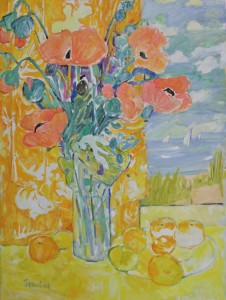
Walking past the windows of The Christina Gallery, one can’t help but notice the bright colors and bold brushstrokes of Lillia Frantin’s “Still Life on a Summer Day.” The large canvas radiates energy while Frantin’s palette of pastel and neon shades illuminates space far beyond the painting’s frame. A bouquet of pink flowers blooms in a glass vase. Green stems create contrast with the orange and yellow backdrop of the painting, and the plate of oranges at the foot of the floral arrangement.

"Still Life on a Summer Day" by Lillia Frantin
“Still Life on a Summer Day” by Lillia Frantin

Lillia Frantin’s influence by Expressionists and Fauvists such as Matisse, Cezanne, and Bonnard is clear. Like her precursors, she tests the limits of representation in her signature loosely painted, energetic still lifes. After teaching Modernist Art History at the university level for twenty years Frantin retired to pursue her painting career full-time. Looking at Frantin’s paintings is like seeing the world through her eyes. As she describes “…Art is really what we all search for in life: understanding and respect, harmony and freedom, connection, vitality, truth and beauty.”

The Christina Gallery welcomes Lillia Frantin’s Modernist oil paintings back after a ten-year hiatus. Her work can be found in collections across the United States and abroad. Come visit us at the gallery and ask us for more information or to see her vibrant works yourself.


The First Gallery Stroll and an Interview with Lloyd Kelly

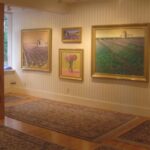
Last night’s reception of Lloyd Kelly’s “Paintings of Provence” coincided with the first Gallery Stroll of Summer 2012. The gallery was filled with visitors from all sides of the island. Guests enjoyed drinks and conversation while looking at paintings by artists such as William Davis, John Traynor, Russell Gordon, Lillia Frantin and four generations of the Pissarro family.

After viewing “Paintings of Provence,” I was able to enjoy a conversation with the artist Lloyd Kelly. He talked candidly about his inspiration for the show, his approach to painting in general, and his interest in the Far East. – Erica Udow, Gallery Associate, The Christina Gallery

An Interview with Lloyd:

The theme of this exhibition is Provence, France. Many artists in history have embraced this subject. What inspired you to continue the tradition?

“Impressionists called themselves Japanesists because they were so influenced by the Japanese. The South of France is inspirational because of the food, the wine…magic light there. It is still a big influence on artists today. There is such diversity of landscape; nature is so present. It energizes the artist and inspires…”

Speaking of inspiration, you have spoken of the influence the eighteenth century Japanese artist Ito Jakuchu has had on your work. How did that develop?

“First of all through textbooks and also through my interest in martial arts and Tai Chi starting as a child. My father was in the military and travelled to Japan. Because of things that my father brought back, I started becoming more and more interested in China and Japan.”

What about Jakuchu’s work appeals to you?

“The specific influence of Ito is that he incorporates asymmetric balance that for the time was very unique. He really is arguably one of the greatest artists of all time.”

Are there other artists whose work you find to be particularly influential?

“Do you know the artist Morandi? Giorgio Morandi was from Bologna. He was very influential on people like Rothko. You name the big artist and they were all looking towards Morandi. He has always been an artist’s artist. He takes very simple objects that are conventional so that [the object], be it landscape or still life, is not about the subject matter at all, it just becomes a way into the subject matter.”

In “Arts & Ideas” you mention that your work is abstract and not only about the obvious subject matter of the painting. Is Morandi’s approach what you are referring to?”

“For example the Chinese and Japanese will paint the same peach blossom for generations. It is not about the peach blossom [itself], but what each artist brings to the peach blossom. Morandi lived with his mother and painted the same objects over and over…dealing with abstract and contemporary issues… moving around space, and color. [He made] the subject matter accessible to the viewer. It is really about something else even though the subject matter is traditional and conventional.”

I read about your use of bourbon as paint thinner in a series of equestrian portraits you painted a few years ago. Have you continued to use this technique in your recent works, or was that an one-off experiment?

“I use lavender oil in the paint. Sometimes, in fact, the UPS people will ask ‘what is this I have in my truck!’ Spike of lavender was used during the Renaissance… It causes the paint to flow. It slows down the drying and one can really draw with the paint. I use it in small passages, often in the lavender blossoms themselves. I sometimes use bourbon or cognac or calvados. I go to the distilleries and they give me the designate, which is completely clear, and does not contain the chemicals and tannins and so forth. It disperses the pigments differently than chemical mediums.”

How did you come up with the idea to use unconventional mediums?

“After school I [completed coursework in] Museum Studies at The Louvre and The Tate. I collected [indigenous materials]. I think it is fun. I think it’s interesting. There’s some sort of an authenticity to it. It is kind of like living off the land. I think that the source is from my museum education at the Louvre.”

Your oil paintings demonstrate an adept ability to manipulate color…

“You can only get about 170 colors [readymade from an art store]. The human eye, untrained, can see up to 700 with no problem. With a little training [it] can see up to a few thousand. The interaction of colors is something that interests me a lot. That is why I do so much under painting. The viewer’s eye mixes the colors. The colors that I mix are [just the first step in creating the final product]. The viewer’s eye brings it together to another place.”


Four Generations: Camille Pissarro & Family

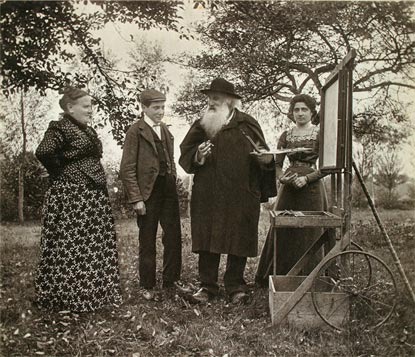
Born on the island of St. Thomas in 1830, Camille Pissarro became a master of the Impressionist movement whose influence extended to not only his contemporaries in Paris, where his career blossomed, but also to his own immediate family. Pissarro learned to paint by carefully observing the changing light during different times of day and different seasons, a legacy he passed on to all those who studied under him.

Of Pissarro’s seven children, four of his sons grew to be respected artists in their own right; Lucien, Ludovic-Rodo, Georges Henri and Paulémile. Lucien, the eldest, was skilled in a variety of media, ranging from oils and watercolors to engravings and lithographs. Aside from studying under his father, he also surrounded himself with such figures as Paul Signac and Georges Seurat. The pointillist style practiced by these two masters affected Lucien’s style, as well as his father’s.

Pissarro with his wife and son, Paulemile, and daughter, Jeanne in their garden at Eragny in 1897

Though Lucien eventually moved to London permanently, playing a large role in spreading the Impressionist movement in Britain, the majority of Camille’s other artistic protégés remained closer to home. Georges Henri, who went by the alias “Manzana” in his earlier years, was a prolific painter and decorative artist who regularly exhibited paintings in the avant-garde galleries and exhibitions across Paris, including but not limited to the “Salon d’Automne” and the “Salon de Independents.”

Georges Henri’s next closest brother, Ludovic-Rodo, was a figure in the anti-academic Parisian art world; his first woodcuts were published in the anarchist journal Le Pere Peunard. Rodo and the youngest Pissarro brother, Paulémile, lived in the Montmarte region and frequented the nightlife and cafe scene there, coming into contact with such Fauvists as Maurice Vlaminck, Kees Van Dongen and Raoul Dufy.

Paulémile’s oldest child, Hugues Claude, who was named after his godfather, Claude Monet, was born in 1935 and is still actively painting. Initially taught by his father, Hugues first exhibited his work at the age of fourteen. He subsequently studied art in Paris at prestigious establishments such as Ecole du Musée du Louvre and, in particular, at Ecole Normale Supérieur, a unique French institution dedicated to the pursuit of achievement and excellence to which only the academic elite have access. Hugues youngest child, Lélia was born in 1963. She has been painting since she was four and was educated by her grandfather, Paulémile. Her interest in drawing and painting was nurtured by her grandfather, who taught her the fundamental impressionist and post-impressionist techniques.


“Paintings of Provence” by Lloyd Kelly

Lloyd Kelly is internationally renowned for his landscape and equestrian oil paintings. He has exhibited at The Christina Gallery since 1994 as well as at galleries and museums around the world including the United States, Mexico, Japan, China, France and Italy.

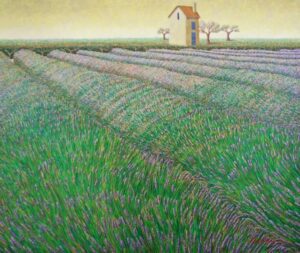
"Juillet en Provence" by Lloyd Kelly
“Juillet en Provence” by Lloyd Kelly

Kelly’s works are often celebrated for their bold use of color and unique asymmetrical balance. High horizon lines simultaneously provide the viewer with both an interesting focal point and an entryway into the canvas. Diagonal lines extend off the canvas out into the viewers’ space, resulting in the dissolution of barriers between reality and the world created by the artist’s brush. This technique allows the viewer to become a part of the painting.

A consistent thread seen in Kelly’s work throughout his career is his use of complementary colors in the fore and background of his paintings. He places great importance on the under-painting of his canvases. The contrast that his layering creates adds dramatic tension to the deceivingly simple compositions and subjects. His selection of beautiful and serene subjects such as lush lavender fields and floral still-lifes are familiar to viewers. Kelly himself frequently reminds the viewer that his work is abstract and that diverse and unexpected meaning can be found in even the most seemingly innocuous subject matters. The painting is not only about the object itself; conventional subjects become a way to express other ideas.

From July 5-19, 2012 The Christina Gallery will have on view an exhibition of original oil paintings by Lloyd Kelly entitled “Paintings of Provence.” Inspiration for the works in this show comes from Kelly’s travels to the south of France. Many master painters in history are either from, or travelled to, Provence. The rolling hills, impressive architecture and surreal natural lighting provide a rich subject matter for this collection of paintings. As Kelly explains, “The south of France is inspirational because of the food, the wine, and the magic light there. It is still a big influence on artists today. There is such a rich diversity of landscape; nature is so present. It energizes the artist and inspires…”

We hope to see you at The Christina Gallery for our first show of the 2012 Summer Season!

Archives

News

  • Contemporary Paintings
  • Sailors' Valentines
  • Antique Works
  • Antique Nautical Charts and Maps
  • Updates
  • Exhibitions
  • News
  • Blog
The Christina Gallery

The Christina Gallery
5 Winter Street
Edgartown MA 02539
508-627-8794
[email protected]

  • Facebook
  • Instagram
  • RSS
Sign up for our newsletter!

Header Image
July Afternoon, Edgartown Yacht Club
Copyright 2026 The Christina Gallery Technology by Tenseg